
By Darren Svan | The Center Square
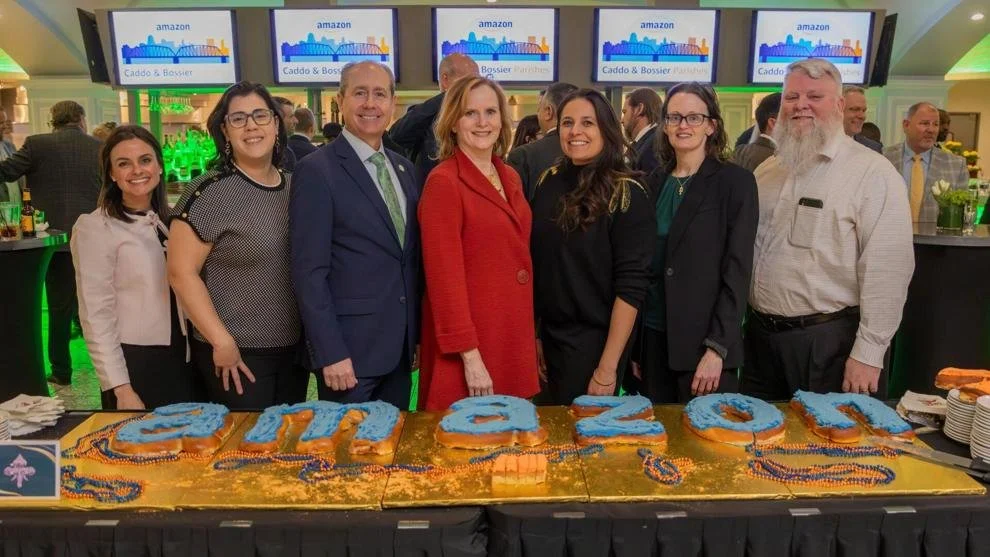
The North Louisiana Economic Partnership team at the Amazon data center announcement event in Shreveport, Louisiana. Photo: Courtesy of North Louisiana Economic Partnership / Used with Permission
The North Louisiana Economic Partnership team at the Amazon data center announcement event in Shreveport, Louisiana. Photo: Courtesy of North Louisiana Economic Partnership / Used with Permission
Shreveport and neighboring communities have long criticized the lack of consistent economic development leadership. Years of stagnant job growth and economic decline became the norm.
The leadership and staff at North Louisiana Economic Development say they are working to move beyond the region’s past and position the organization as one of the region’s principal business recruiters.
With leadership comes the price of managing expectations and acknowledging dissatisfaction.
NLEP played a key role in securing Amazon’s pledge to spend $12 billion on multiple data center campuses, the largest single investment in the history of northwest Louisiana.
But positive developments present challenges.
The deal with Amazon caused friction, raising concern about the lack of public information, the risk of rising utility cost, the fear of noise pollution and distrust of job creation projections.
Friendly and armed with a repertoire of Southern idioms, Justyn Dixon had no illusions when he was hired as president and chief executive officer of NLEP, a nonprofit tackling the complex task of aligning taxpayer, political and corporate priorities in pursuit of job growth.
Dixon was recruited in 2021 from Mississippi, where he worked as a regional development executive and industrial portfolio manager across four states. As his career progressed, he developed a passion for economic development.
“I firmly believe our organization can do anything,” he said. "I don't think we can do everything, but I do believe we can achieve much more than we have in the past."
Before joining NLEP, Dixon developed projects in Mississippi, Alabama, Arkansas, Texas, Tennessee, and Florida – but none in Louisiana. That puzzled him because, along with its proximity to major economic centers like Houston or Dallas, the region has critical rail lines, interstates and a pipe-line of job seekers.
“We have great assets, and that’s what brought me here to begin with,” he said. "I think those assets are now being realized and leveraged."
Dixon’s stewardship brings a focus on setting goals and achieving them, never resting on laurels.
“Our mission is to recruit jobs and investment – so we're always trying to do that bigger, faster, stronger," he said.
NLEP played a central role in a number of recent economic announcements that attracted billions in investment dollars and promises of hundreds of high-quality jobs, in its attempt to position northwest Louisiana as an industry hub.
The project with Amazon and its developer, STACK Infrastructure, was negotiated confidentially because Shreveport-Bossier was competing with other states or cities to get to the finish line first, which created dissatisfaction with those who want transparency.
“Basically, the last person standing is the winner,” Dixon said.
Non-disclosure agreements protect confidentiality and maintain a competitive edge during recruitment. But it’s that secrecy – company identity and monetary incentives – that frustrated residents.
Public disclosure of Amazon’s interest in northwest Louisiana risked jeopardizing the project.
“We don't want to put these companies at a disadvantage by slipping out some information that might drive up cost to do business, and then you miss opportunities,” he said.
NLEP involved city and parish elected officials from the outset, and then kept them informed throughout.
Granting large tax subsidies to profitable corporations also raised concerns. Organizations that monitor activity say states are forgoing hundreds of millions in tax revenue, causing some state agencies to place moratoriums on future development.
“The conversation is usually one-sided – people ask what we give up, not what we gain,” he said. "And the answer is always the same: you're giving up 100% if they never locate here. From the economic development perspective, we don't get one penny if they don't come here, not one penny."
Local taxing entities benefit from the sale of water, electricity, and building materials to Amazon, plus they collect substantial property taxes.
There’s an expected economic ripple effect that includes workforce development opportunities around new buildouts and the demand for construction-related services is expected to last for more than three years.
Much of the recent positive economic momentum, Dixon said, is attributable to “timing” and “alignment.” Gov. Jeff Landry is prioritizing business recruitment and industrial expansion from the state level, while northwest-area elected leaders, businesses and organizations are creating conditions locally that attract expansion and growth.
“I believe we have a great environment that's being put forth by our elected officials,” he said.
Dixon also credits his seven-person staff working quietly behind the scenes collaborating with stakeholders and advancing opportunities across 11 parishes. Louisiana Economic Development is a state organization that partners with eight regional non-governmental organizations, like NLEP, covering every parish as regional business recruiters.
Over the past two years, the state forged stronger ties with regional NGO partners.
“They do more boots on the ground because they understand their local communities, partnerships, resources and geography,” said LED Secretary Susan Bourgeois.
“Justyn is pretty direct and will give you the answer, whether you like it or not,” she said. "I also think he is relentless in getting wins for that region. He focuses on winning the projects that he wants to win."
NLEP is governed by a private board of directors and funded primarily by investors, with roughly 90% of its support coming from private investment and 10% from the state. According to state documents, LED provided the organization with $192,500 through a cooperative endeavor agreement. Dixon said the money includes a restriction for uses like site development, marketing and recruiting.
Around 150 businesses and organizations are listed on its website as local investors, spanning finance, construction, real estate, utilities, education, manufacturing and public administration.
“The diversity, the impact and the return on investment is hard to argue that they aren’t doing an effective, successful job in economic development,” Bourgeois said.
“We understand what elected officials want – job creation and tax growth – and they trust us to work within those guardrails,” Dixon said.