
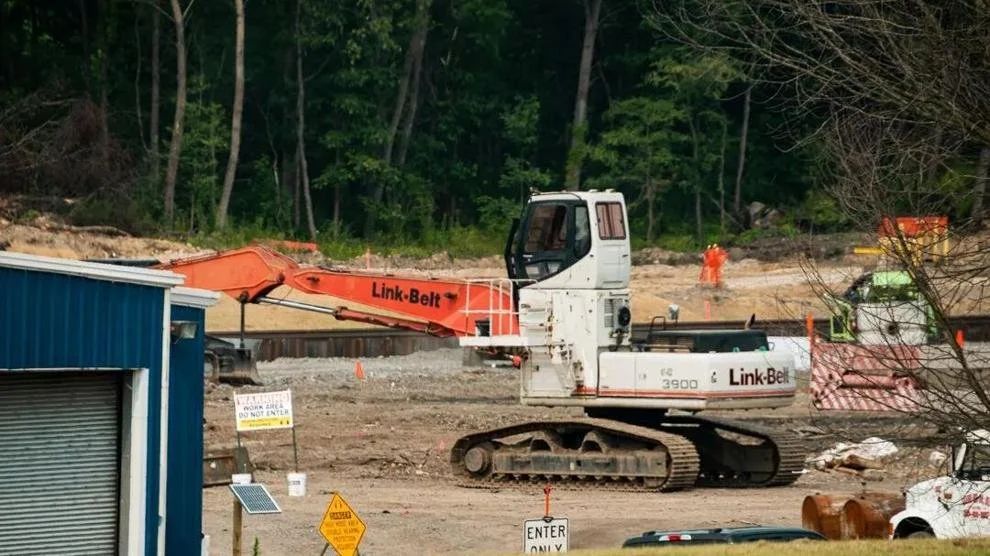
An excavator is parked at a construction site. Photo: Grace David / The Center Square
By Darren Svan | The Center Square
The Metropolitan Planning Commission approved “dramatic” reforms to Shreveport building standards that were interpreted as barriers to business and economic growth for the city.
An ordinance to reform city codes for landscape design standards is slated for review by the City Council on May 29 and June 9, when a public hearing is scheduled. The council will consider whether to turn the commission’s recommendation into law.
The proposed revisions apply to “landscape design standards,” including planting shrubs as buffers, the number of required parking lot islands and the procedure for developing an acceptable landscape plan.
Small and large developers and business startups could potentially save significant money in initial capital investment, plus the recurring cost of upkeep and maintenance.
Many of the economic assumptions city leaders relied on in their planning decisions made 15 to 20 years ago have not come to fruition. Rather than growing, Shreveport’s population is shrinking, according to the latest census data.
“What we did before did not work,” said Stephen Jean, the commission’s interim executive director.
The new rules were crafted to be business-friendly while “enhancing the overall environment of the city,” Jean said, stressing that their approach today strikes a balance between promoting aesthetics for residents and practicality for businesses.
A decade ago, the city adopted “sophisticated” landscaping regulations guided by the Shreveport-Caddo 2030 Master Plan, a framework for land use, transportation, housing, economic development and neighborhood revitalization, according to city documents.
“Throughout the past 10 years, the landscaping standards have remained a pain point for developers,” the commission staff said in a statement.
Longtime builder Fred White, owner of Commercial Construction and Development, said “We’ve seen a slowdown in our work in that period of time, not only due to that but other economic factors, too.”
City and parish planning officials recognized that the rules they put in place were misguided.
According to Jean, explaining and justifying the cost of their landscape requirements to small business owners and entrepreneurs was difficult, and resulted in lost growth opportunities.
“It’s the right move at the right time,” he said. “It’s not one side or the other; we have to work at what’s best for the city today.”
The landscaping UDC codes are hindering growth, the commission staff wrote, a sentiment echoed by several prominent real estate developers.
“It costs more to build small and large buildings here than it does in Dallas or Houston, even though we have a lot cheaper land,” said Mark Sealy, president of Sealy and Company, during the commission’s public hearing.
Mayor Tom Arceneaux asked planning officials to review the UDC. Jean and his team met with Shreveport Green, architects, commercial developers and the Committee of 100, an organization made of 130 of the largest employers.
The Committee of 100’s chief executive officer, Jeffrey Goodman, expressed appreciation during the hearing for being permitted to participate, and offered the committee’s support for the reforms.
Jean’s “outreach” process with the community is a model of what the planning department should be doing going forward, the commission board said.
“Theoretically, (the current code) is a great idea,” Jean told The Center Square. “If we were not a shrinking city, it’s a great idea. When you live in a shrinking city, and you have lots that are vacant all over the city, does it make sense for us to have provisions like that? If we had a lot more development pressure, then we could have some higher standards.”
On May 6, the commission voted unanimously in favor of the unified development code revisions. During their public hearing portion of the meeting, four people spoke in favor. No one offered opposition.