
Editorial by Wes Merriott
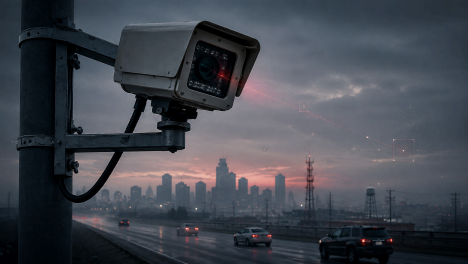
Bossier Parish should approach mass vehicle surveillance differently from an ordinary American community. Air Force Global Strike Command is headquartered at Barksdale Air Force Base and oversees the nation's three Air Force intercontinental ballistic missile wings, the entire Air Force bomber force and Air Force nuclear command, control and communications systems. Barksdale's 2nd Bomb Wing operates three B-52H squadrons and is the largest bomb wing in the Air Force. Bossier City also hosts the Cyber Innovation Center and National Cyber Research Park, while Speaker of the House Mike Johnson maintains his personal residence and an official congressional district office here.
Against that backdrop, the Bossier Parish Republican Executive Committee unanimously adopted a resolution on August 3 calling on local governmental bodies to reject Flock Safety automated license plate readers and similar mass-surveillance systems. The resolution calls for an immediate halt to new contracts and urges review of existing systems, with particular concern for mass collection, data retention, third-party sharing, accuracy and public oversight.
The national-security problem deserves particular attention because vehicle data does not have to contain a person's name to become sensitive. A database need not contain names to have intelligence value if a particular vehicle can later be associated with a person, organization or facility. Repeated observations can reveal when a vehicle appears, where it regularly travels, what facilities it visits and which other locations appear in the same pattern. In a community containing senior military leadership, nuclear-enterprise personnel, defense contractors, congressional staff and cybersecurity professionals, that capability deserves far more scrutiny than an ordinary traffic camera.
From License Plate Reading to Location Intelligence
Flock's own materials explain that its ALPR systems collect license plate images, vehicle characteristics, date and time stamps, and the location of the camera making each observation. Flock says its default retention period is 30 days, searches are logged, access is role-based and its ALPR system does not use facial recognition. Those are meaningful limitations and should be represented accurately.
A single observation on a public road reveals relatively little. The capability changes when large numbers of cameras create searchable observations across time and geography. Computers can organize those observations, correlate them and retrieve a vehicle's prior appearances almost instantly, creating a retrospective investigative capability that did not exist when an officer simply saw a plate while standing beside a road.
That distinction is central to the privacy debate. Driving past a camera at 10:13 a.m. may be mundane. A searchable collection showing that the same vehicle routinely appears near a particular residence, church, political meeting, medical facility, attorney's office or military workplace can reveal substantially more.
The Fourth Amendment Question Is Developing Rapidly
Louisiana has unusually strong constitutional language on this issue. Article I, Section 5 of the Louisiana Constitution protects every person against unreasonable "searches, seizures, or invasions of privacy," giving Louisiana officials an independent reason to take location aggregation seriously.
Federal courts have not held that ALPR networks are categorically unconstitutional. In January, a federal district judge ruled for Norfolk, Virginia, in Schmidt v. City of Norfolk, rejecting a Fourth Amendment challenge to that city's extensive Flock network on the record presented. The plaintiffs appealed, and Fourth Circuit Case No. 26-1227 remains a live constitutional challenge involving organizations including the Cato Institute, Electronic Frontier Foundation, ACLU, Electronic Privacy Information Center and Innocence Project as amici.
The constitutional landscape changed again on June 29. In Chatrie v. United States, the Supreme Court held 6-3 that police conducted a Fourth Amendment search when they obtained a person's historical cellphone location data from Google because individuals retain a reasonable expectation of privacy in cellphone location information. The Court vacated the lower ruling and returned the case for further proceedings.
Chatrie does not decide the constitutionality of Flock cameras. It does, however, make the familiar argument that private companies already collect location information much less satisfying. The Supreme Court has now reaffirmed that digital location information can carry Fourth Amendment significance even when a third-party company possesses the records.
There is another important difference. Drivers cannot meaningfully opt out of a government ALPR network while traveling ordinary public roads. When the government systematically collects the location observations of people who are suspected of no crime, officials should expect constitutional questions about scale, duration, access and aggregation to grow rather than disappear.
Errors Become Serious When They Reach the Street
The case for caution also rests on documented operational failures. In July, CBS Minnesota reported that four police vehicles converged on automotive journalist Joel Feder after Flock cameras repeatedly alerted on the Range Rover he was driving. An incomplete stolen-plate entry in a national database, combined with how the plate was read and matched, resulted in Feder's legitimate vehicle being treated as a potential stolen-plate match. Flock emphasized afterward that an automated alert should form only one part of an investigation.
In Sherwood, Arkansas, a Flock camera reportedly misread a license plate by one character earlier this year, contributing to police detaining an innocent couple at gunpoint while their six-week-old child remained in the vehicle. The Institute for Justice has catalogued that incident along with other erroneous ALPR-related stops.
The scale becomes clearer in Los Angeles. An LAPD inspector general review found more than 210 million plate scans during a two-month period and identified 161 instances in which a vehicle flagged as stolen was ultimately determined not to be stolen. During the same review period, 337 alerts resulted in stolen-vehicle recoveries. The report also identified weaknesses involving data security, privacy and access-control provisions.
Misuse Is No Longer Hypothetical
Technical safeguards cannot eliminate authorized-user abuse. On July 6, the Georgia Bureau of Investigation announced the arrests of five former Albany Police Department officers after an internal audit found that they had allegedly accessed retained Flock license-plate information on multiple occasions for non-law-enforcement purposes. The former officers were charged with misuse of license plate data and violation of oath of office.
Audit logs helped expose the alleged misconduct, which is an argument in favor of strong auditing. They also demonstrate the limitation of relying on audit logs as the primary safeguard. Logging can reveal what an authorized user did after sensitive information has already been accessed.
Inter-agency access raises another concern. Mountain View, California, shut down its Flock cameras after a police-initiated audit found that city data had been accessed by federal and state agencies contrary to the city's approved policies. The City Council unanimously terminated the contract in February. Redmond, Washington, voted 7-0 in July to end its Flock program after its own review, and Fridley, Minnesota, recently disclosed that its network had previously been open to out-of-state agencies and had been searched hundreds of thousands of times.
These cases do not prove that Bossier agencies are misusing Flock. They prove that policies, permissions, sharing configurations and individual conduct require independent verification rather than assumption.
Bossier's Cybersecurity Standard Should Reflect Bossier's Risk
Flock deserves credit for maintaining a substantial cybersecurity program. Its public security center lists SOC 2 Type II, ISO 27001 and several related ISO certifications, CJIS-related controls, FedRAMP 20x, NDAA compliance and TX-RAMP Level 2. Flock also says its cloud platform has never suffered a breach in which customer information was accessed or exfiltrated by an attacker, and it reports using encryption and AWS infrastructure for stored information.
Flock does not publicly list CMMC among those credentials. That fact should not be exaggerated. CMMC applies within the defense industrial base when contractors or subcontractors process, store or transmit Federal Contract Information or Controlled Unclassified Information under covered Department of Defense contracts; municipal ALPR data outside Barksdale do not become subject to CMMC merely because the cameras operate near a military installation.
CMMC nevertheless provides a useful comparison in risk management. The Department of Defense demands heightened assurance when private companies handle information whose compromise could harm defense interests. Local officials should ask what level of independent cybersecurity review is appropriate when a commercial system collects and makes searchable movement information in the immediate environment of Air Force Global Strike Command, nuclear-enterprise personnel and one of America's most strategically important military installations.
The absence of a known breach is reassuring, but past performance cannot answer the entire policy question. Cybersecurity planning also examines what information could be exposed, who would value it, how authorized access might be abused and what consequences would follow if existing safeguards failed.
The Public Deserves the Records Before the Cameras Become Permanent
Public records requests have now been sent to governmental agencies throughout Bossier Parish seeking information about Flock administration, authorized users, policies and safeguards. Those requests should help establish who can search local information, how access is monitored, what sharing relationships exist and what restrictions actually govern use.
The results may demonstrate responsible users, restrictive policies and strong controls. They may expose gaps requiring immediate correction. Either outcome serves the public because decisions about population-scale surveillance should be based on documented configurations and actual practices rather than assumptions about how a system is supposed to operate.
Bossier Should Act Before Surveillance Becomes Infrastructure
Flock cameras have legitimate law-enforcement utility. Police departments credit ALPR systems with recovering stolen vehicles, locating missing people and developing leads in serious crimes. Redmond itself described those public-safety purposes even as its elected council ultimately decided to terminate the program.
The question for Bossier Parish is whether those investigative benefits justify maintaining a system that collects searchable location observations involving thousands of innocent motorists so that information will be available if one of them later becomes relevant to an investigation. Louisiana's express constitutional protection against invasions of privacy, the Supreme Court's renewed attention to digital location data, ongoing ALPR litigation, documented misuse and Bossier's extraordinary national-security environment provide compelling reasons to set a higher threshold.
Local governments should suspend new Flock-type purchases, expansions and contract renewals while the pending public records are examined. They should publicly disclose users, sharing arrangements, retention rules, audit procedures and documented safeguards, then consider ordinances prohibiting Flock and substantially similar mass vehicle-location systems rather than adopting a ban limited to one company name.
Bossier Parish has an opportunity to make that decision before a major misuse, wrongful stop or security incident makes it for us. Effective policing can survive reasonable limits on mass data collection, and a community entrusted with such an important role in America's national defense should be willing to demand those limits.
Wes Merriott is the editor of SOBO.live and longtime political observer in Northwest Louisiana. He is also the Vice Chairman of the Bossier Parish Republican Executive Committee