
BY JONAH MEADOWS | NOLA.com

Attendees gather for the Red White and Boom! Youngsville Independence Day Celebration on Thursday, July 3, 2025, at the Youngsville Sports Complex. According to U.S. Census data, Youngsville is among the fastest-growing cities in Louisiana, adding more than 4,000 residents since 2020.STAFF PHOTO BY BRAD BOWIE
Of the 305 cities, towns and villages in Louisiana, nearly 3 out of 4 lost residents from 2020 to 2025, according to population estimates released this month by the U.S. Census Bureau.
In the 18 cities with more than 20,000 people, more than half are shrinking, including New Orleans, which this year dropped below Cleveland to become the 54th most populous in the nation.
Meanwhile, the population has declined in 50 of Louisiana’s 64 parishes, with a net loss of nearly 40,000 residents statewide. Were it not for international migration, that number would be more than three times larger.
It’s no mystery where people are going.
“You can almost hear the sucking sound of Houston and Dallas pulling our people that way,” said Tim Slack, a sociologist at LSU.
The top five fastest-growing cities in the country, and six of last year’s 10 biggest population gainers, are all in Texas, according to census data.
052426 Census Cities chart
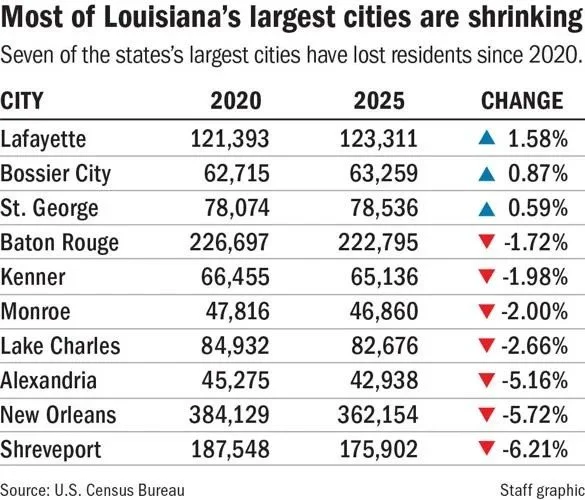
Intra-state moves
The latest municipal-level population estimates show that Louisianans are not only leaving the state but redistributing themselves around it.
Of the state’s 10 metropolitan areas, only two principal cities — Hammond, and Lafayette — have posted significant growth. Instead, most of the cities, towns and villages that have added residents are located outside the urban center.
“Both in terms of absolute growth and percentage growth, we're largely not talking about the principal cities that anchor metro areas, we're talking about communities that surround those places,” Slack said.
Lafayette Parish presents a microcosm of this pattern. The parish has grown by 6.7% since 2020 even as the city itself grew by just 1.6%. Surrounding communities — such as Carencro, up 43%, and Youngsville, up 26% — are fueling that growth.
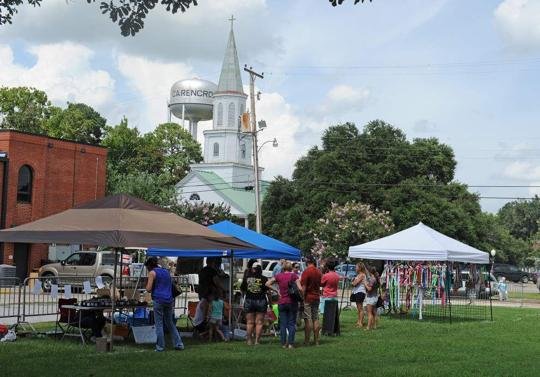
The Lafayette Parish city of Carencro, shown in a 2015 file photo, added nearly 4,000 residents between 2020 and 2025, making it one of the fastest-growing cities in the state.
BY BRAD BOWIE | The Advocate
While high costs and safety concerns contribute to pushing residents out of the state’s core cities, more affordable housing and more appealing school districts are helping in pulling residents toward the suburban and exurban fringes of metro areas, experts say, as long as they remain within commuting range of jobs.
Work-life balance
Allison Plyer, chief demographer at The Data Center in New Orleans, said the No. 1 reason that people are willing to move long distances is because of work opportunities, followed by social networks.
“People will tolerate very high housing costs if there are jobs,” Plyer said.
But the number of jobs in Louisiana has grown by less than 1% over the past decade, compared with a national average of nearly 10%, according to total nonfarm payroll data from the Bureau of Labor Statistics.
“Someone might move from New Orleans because of poor schools to St. Tammany — that's true,” Plyer said. “But in terms of the total population loss, it's because we have stagnant job growth.”
Last year's jobs data is somewhat more promising. The state added about 3,300 people from 2024 to 2025 while adding about 8,300 jobs. That could signal continued population growth on the horizon.
But, at the same time, the international immigration to Louisiana that's offset the number of people who move out-of-state has dramatically slowed since 2024. And, if current trends continue, the Census Bureau projects international migration will decline by another 75% next year.
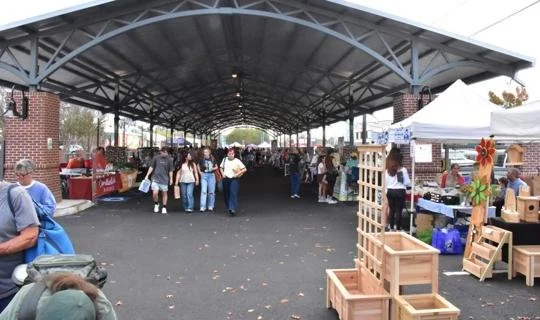
Hammond has grown by nearly 23% in the past five years, the most of any Louisiana municipality with 20,000 people or more. The Tangipahoa Parish city, shown in a 2025 file photo, added nearly 4,500 residents since the last U.S. Census.
Photo by Richard Meek
For Louisiana, which would have lost more than 130,000 residents since 2020 were it not for migrants from abroad, that decline could erode any population growth fueled by recent job creation.
Getting smaller
The places that have lost the largest share of their population are all communities of fewer than 10,000 people.
Of the 22 towns to have shrunk by 8% or more since 2020, a majority are located in the Upper Louisiana Delta in the state’s northeast corner.
As for the largest cities in the state, there are some encouraging signs.
Baton Rouge has posted two years of modest population gains following three years of declines, though it remains more than 3,000 people smaller than it was in 2020.
Lake Charles, which suffered one of the sharpest population drops in the nation after it was struck by hurricanes Laura and Delta in 2020, has now posted three consecutive years of growth, adding more than 1,200 residents from 2024 to 2025 — though it remains nearly 2,300 people smaller than it was before the hurricanes.
And in New Orleans, which has lost 22,000 people over the past five years, the rate of decline has slowed. The Big Easy shrank by only about 1,300 people last year compared with an average of nearly 5,000 people each of the previous four years.
But a slowing decline does not necessarily signal growth to come.
Even if New Orleans were to create a massive surplus of jobs, Plyer explained, the people who fill them could wind up living outside the city.
“It's interesting that the mayor is saying she's going to turn around the population loss. That is something that one Detroit mayor after the next has promised to do and not succeeded,” she said. “It's a very, very hard thing for a single city to do because they're part of a metro area.”