
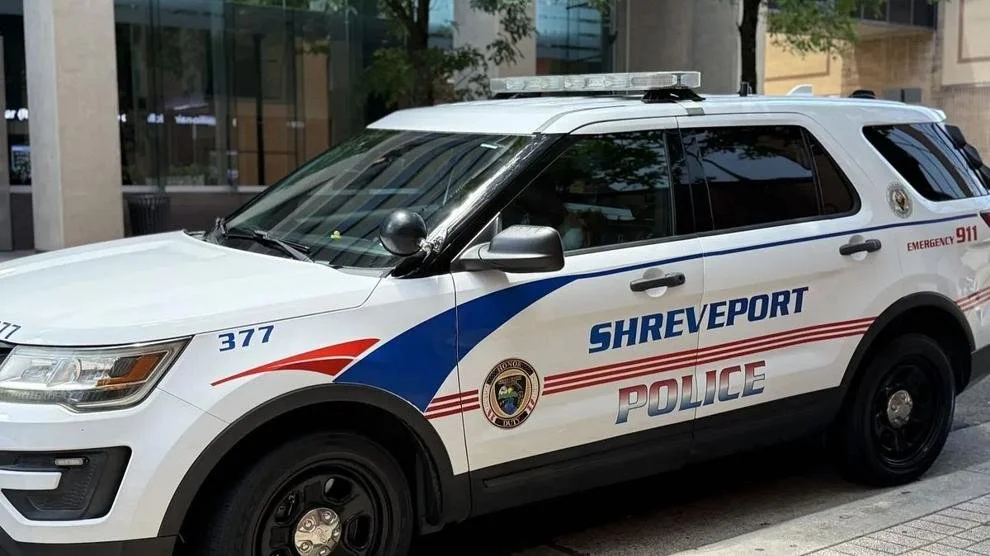
A Shreveport Police vehicle is parked in downtown Shreveport, La. Photo: Emilee Calametti / The Center Square
By Darren Svan | The Center Square
Convicted violent felons ineligible for early release under current law are still leaving prison early because the date of their crimes are governed by more lenient parole rules stemming from justice reforms enacted nine years ago in Louisiana.
State lawmakers say it is unfortunate but a reality that individuals convicted of crimes – including violent crimes – prior to August 2024 remain eligible to serve a fraction of their prison sentence.
“A lot of the prison population falls under the old sentencing scheme,” said Rep. Debbie Villio, R-Kenner, who authored sentencing reforms in 2024.
That early-release dynamic made it possible for Timothy Christian to join others celebrating the Fourth of July in downtown Shreveport, where he shot a Shreveport Police Department officer and was killed when she returned fire.
Christian would still be in prison until at least 2028 under legislation enacted two years ago by Gov. Jeff Landry and the Legislature.
Crimes and convictions that occurred before Aug. 1, 2024, fall under the more lenient 2017 statutes. This allowed his “good time” release after serving 18 months of a five-year sentence for possessing a firearm as a convicted felon, according to court documents and state officials.
The Criminal Justice Reinvestment Act of 2017 reclassified that weapons charge as a nonviolent crime, according to the legislation.
“That crime has become the No. 1 nonviolent crime in Louisiana,” Villio said. “He benefited from the reclassification and then his good time credit.”
Christian and several other men were fighting in an alley when the officer arrived in the early morning of July 5, where she attempted to separate them. Christian pulled his weapon and shot the officer, who returned fire after her ballistic vest stopped the projectile, according to police.
The officer is expected to make a full recovery, police said.
The state’s "truth-in-sentencing" laws implemented two years ago reversed much of the justice reforms, enacted to reduce incarceration rates and corrections costs. But inmates’ release dates are governed by when their crime or conviction was carried out.
“If I could change it, I assure you we would have but we can’t,” Villio said.
The new laws significantly tightened opportunities for good time early release – now inmates are required to serve 85% of their sentence and parole was eliminated.
“In a case like Timothy Christian, we see somebody with his prior record serve very little time, and then he goes out and shoots a police officer, not because he was released by mistake,” Villio told The Center Square. “He was released based upon the laws in place for him.”
Between 2021 and 2024, Christian faced seven felony charges across four criminal cases. Five were dismissed and two resulted in convictions: aggravated battery in 2021 and carrying concealed weapon by convicted felon in 2024, resulting in a five-year sentence, according to District Court documents.
The aggravated battery conviction stemmed from a 2020 attempted second-degree murder charge that prosecutors later reduced to aggravated assault. As part of that deal, two weapons-related charges were dropped in that case, according to a review of case documents.
The Center Square, at time of publication, was unable to obtain a copy of his 2020 arrest report.
The Department of Public Safety and Corrections is the agency that released Christian under the provisions of his good time parole date. It’s unclear what criteria the agency applied to formulate a release date at 30% of his sentence.
The Center Square was unsuccessful getting calls returned from the agency.
The calculation to determine parole eligibility is under the purview of public safety and corrections, not the state's board of pardons and parole, a state official told The Center Square.
“We did it for situations like this,” said Sen. Thomas Pressly, R-Shreveport. “I think there is no doubt that the moves under Governor Landry were necessary and needed for this exact scenario.”
According to the new laws, Christian would likely have been released sometime in 2028 under current statutes, at either 85% of his sentence for good time or if he served his full sentence.
“It helped us reset Louisiana’s criminal justice approach to protect the public,” Villio said. “When we align around public safety, crime goes down. There has been a reduction in crime across the board, and we believe that is in large part to our tough on crime legislation.”
Villio said of the nearly 2,000 prisoners released following the 2017 reforms, more than half were rearrested, many of them for violent crimes or sex offenses.