
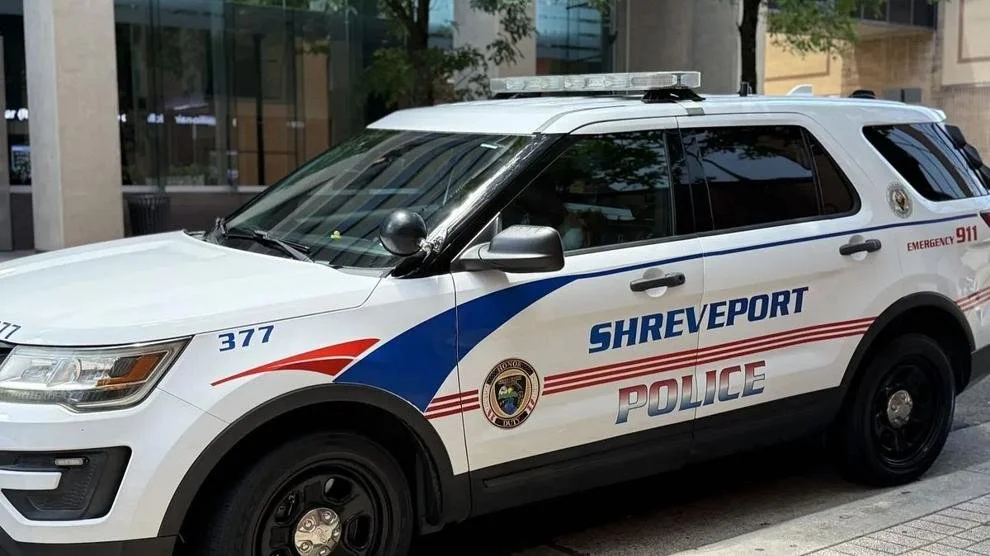
A Shreveport Police vehicle is parked in downtown Shreveport, La. Photo: Emilee Calametti / The Center Square
By Darren Svan | The Center Square Jul 3, 2026
The Caddo-Shreveport Crime Stoppers says years of criminal justice reforms and expanded diversion programs have cut its court fee revenue by more than half, leaving the nonprofit increasingly dependent on donations to stay open.
The nonprofit unsuccessfully asked lawmakers this year to restore some of its lost funding, Executive Director Terry McNaight said.
Their effort to restore the local organization’s previous funding support was not acted on, according to the director.
The nonprofit is funded through a court fee assessed on defendants convicted of criminal or traffic offenses. Crime Stoppers’ portion is $2 per case, which is in addition to all other fines, penalties and costs imposed by the court, the 1991 legislation said.
However, criminal justice reform enacted in 2017 gave courts discretion to determine if a defendant can afford their fines and fees, and if not, the authority to waive all or part of their fee obligations or create a payment plan based on the defendant's ability to pay, according to a legislative document.
“With this mandate, plus court divergence and decriminalization, Shreveport Crime Stoppers’ funding has been cut by more than 50%,” McNaight wrote in a letter to lawmakers.
A review of Crime Stopper audits shows both city and district court fees collected for the organization dropped by 54% over the last decade. For example, around $33,600 was collected from city court in 2015, which dipped to $15,320 in 2024.
McNaight fills the funding shortfall with private donations.
“Our $2 has never been increased from inception so that's a struggle we have,” McNaight said. “We have good contact with all of our agencies, so we don't really have a problem there, but the struggle is just knocking on doors and trying to secure funding every year – because nothing's guaranteed.”
Just over 77% of the nonprofit’s budget was funded by contributions, grants or fundraising, according to the audit. Without them, McNaight said, “We would have to shut the doors. We couldn't operate because we couldn't afford to pay anyone.”
In the last 12 months, Crime Stoppers provided law enforcement agencies with 1,614 anonymous tips or leads. The majority of those fall within four categories: narcotics, violent crime, robbery and homicide.
As of May 31, the nonprofit has paid nearly $50,000 to tipsters for information leading to arrests or indictments in multiple cases.
McNaight discussed last year’s arrest of Kendrick Jones, accused of repeatedly hitting a woman in the face using brass knuckles, to highlight the nonprofit’s impact.
Crime Stoppers tips helped law enforcement locate Jones in Long Beach, Calif. He faces two counts of domestic abuse battery with child endangerment and one count of battery of a dating partner with a dangerous weapon, according to a Caddo Correction Center document.
“It was so egregious – assaulting somebody in the face with brass knuckles – that we decided to put a $5,000 tip on it,” he said. “One of the tips told us that he was in the Los Angeles area, so we worked with Crime Stoppers of LA to get that information out there.
“I didn't transfer it to them because I wanted to keep tabs on it. One person actually gave us his location at an apartment complex, so we were able to get that warrant transferred out to the Long Beach police, who arrested him and then extradited him back here, and that's where he sits right now on a million dollar bond.”
McNaight is interested in conducting more community outreach at local high schools and creating more proactive programs but his budget is far too limited. At one time, the agency’s anonymous tip fund hit a low of $900, he said.
“It’s frustrating since we were created by the Legislature to serve an important function, only to have the Legislature derail our funding,” he wrote in his letter to lawmakers earlier this year.