
At Monday’s work session the Caddo Commission on a 7-5 vote declined to advance a proposed man camp ordinance proposed by Commissioner John-Paul Young after parish attorney Donna Frazier said that zoning would be required to implement the ordinance, that zoning could only be enacted after the Commission adopted a master plan for the parish.
Many have questioned Frazier’s analysis and criticized her failure to suggest alternative options for regulation.
Undaunted John-Paul is now proposing alternative legislation which will be discussed tomorrow (Thursday) at the Commission’s Special Projects Committee meeting at noon. Young, who has a law degree, will now try to get the committee to recommend to the full commission a glorified property standards ordinance “establishing permit, construction site, occupancy, and enforcement standards for temporary workforce housing camps in the unincorporated areas of Caddo Parish, providing for coordination with state health and construction code requirements.”
The well-drafted and researched proposal is worthy of serious consideration by both the committee and the parish attorney who, along with the Administration, is generally unreceptive to new regulations that may impose additional parish work resources.
If cold water is poured on this effort, one can expect a declaratory judgment action will be filed in Caddo District Court to obtain a judicial ruling on the legality of the ordinance provisions.
Commissioner John-Paul has also prepared an excellent “Executive Summary” of the Temporary Workforce Housing Camp Ordinance, which appears below.
Commissioner John-Paul is to be commended on his research, his new ordinance and executive summary along with his diligence.
EXECUTIVE SUMMARY
Temporary Workforce Housing Camp Ordinance
What This Ordinance Does
This ordinance sets up a permit and inspection system for temporary workforce housing camps, sometimes called man camps, in the unincorporated parts of Caddo Parish. These are facilities built to house workers for a construction, industrial, or energy project for a limited period of time, using trailers, modular units, or similar structures.
Anyone who wants to operate one of these camps in the parish will need to get a permit, meet safety and sanitation standards, and be inspected on a regular basis. The ordinance also sets fees, a security deposit, and penalties for violations, and gives an operator the right to appeal a permit decision.
How It Works, in Plain Terms
- Building safety. Every trailer, modular unit, or other structure in a camp has to meet the same state construction code that already applies to any building in Louisiana.
- Parish permit. Before a camp can open, the operator has to get a permit from the Parish Public Works Department, on top of any permit the state already requires for this kind of facility.
- Site and infrastructure standards. The operator has to submit a site plan showing water, drainage, and sewer service, and has to meet minimum distances between structures for fire and emergency access.
- Occupancy limits. A camp cannot house more people than its water, sewer, and emergency exit capacity can safely support.
- Renewal and inspection. Because these camps change quickly as project needs change, the permit has to be renewed and the camp reinspected every three months, not once a year.
- Fees and bond. Application and renewal fees are capped at two hundred fifty dollars each.
Operators also have to post a bond, set at fifteen hundred dollars per structure, to cover cleanup if they walk away without properly closing the camp down.
- Closing down. When the project ends, the operator has to get a final inspection, turn in the permit, and remove the camp within sixty days.
- Enforcement. Violations can be fined, and a camp that will not stop operating after its permit is suspended can be shut down through the courts.
- Appeals. An operator who disagrees with a parish decision can appeal to the Parish Commission, and after that, to the courts.
Where the Parish’s Authority to Do This Comes From
This ordinance rests on two different sources of legal authority, and the difference between them matters.
The first source is simple and does not depend on any decision by the Parish Commission. State law already requires every parish in Louisiana to enforce the state building safety code, no matter what kind of local government that parish has. Caddo Parish does not need special permission for the building safety requirements in this ordinance; they apply because state law says they must, the same way they already apply to every other building project in the parish today.
The second source is the Parish’s own Home Rule Charter, adopted by Caddo Parish voters in 1984. Under the Louisiana Constitution, the elected governing authority of a home rule parish may decide, by ordinance, to regulate for the protection of public health and safety, unless the state legislature has specifically taken that power away. The rest of this ordinance, meaning the permit requirement, the site standards, the occupancy limits, the fees, the bond, and the enforcement and appeal process, rests on that authority. No state law has been found that takes this particular power away from the parish, and the state’s own health code for these kinds of camps expressly allows a parish to require its own permit alongside the state’s permit, which supports the view that the parish is acting within its authority.
This second source is best understood as a prerogative that the elected Parish Commission may choose to exercise. No Louisiana court has yet ruled on this exact question, so adopting this ordinance is the Commission’s own assertion of that authority through the normal legislative process, rather than something granted in advance by a specific statute. This draft is being brought to the parish attorney and to committee so the decision can be made with full and careful information.
Why This Is Different From the Earlier Draft
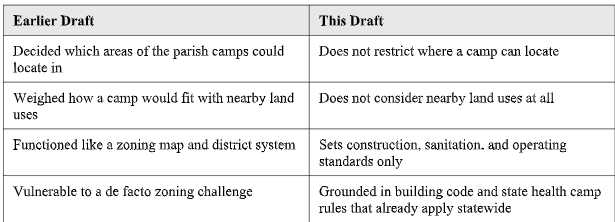
An earlier draft of a workforce housing ordinance ran into a problem: even though it was not labeled a zoning ordinance, the parish attorney’s office viewed it as functioning like one anyway, what is sometimes called de facto zoning. That concern is worth taking seriously, because what matters legally is what a law actually does, not what it is called.
The earlier draft ran into this problem because it made decisions about where camps could go. It effectively divided the parish into areas where camps would be allowed and areas where they would not, and weighed how a camp would fit in with the surrounding neighborhood. That is exactly the kind of decision zoning law is built to handle, and zoning comes with its own
separate legal process, including a formal master plan, public hearings run through the Metropolitan Planning Commission, and a zoning map. Outside the MPC’s planning boundary, that process is not currently available, so an ordinance that functions like zoning without going through it is vulnerable to challenge.
This draft is built around a different, narrower question. Instead of asking where a camp should be allowed, it only asks whether a camp, once someone chooses to put one on their land, is built and operated safely. It borrows its authority from the same kinds of rules that already apply statewide to construction sites, trailer parks, and work camps, rules that do not care what part of the parish a project is in.
Side by Side Comparison
What This Ordinance Does Not Do
- It does not create a zoning map or zoning districts.
- It does not say that camps are allowed in some parts of the parish and prohibited in others.
- It does not compare a proposed camp to the character of surrounding property.
- It does not change or affect zoning within the Shreveport-Caddo Metropolitan Planning
Area.
In short, this ordinance works the same way a building permit or a restaurant health inspection does. It sets rules for how something has to be built and operated, without deciding where it is allowed to exist in the first place. That is the central difference from the earlier draft, and it is the reason this version is built to withstand the de facto zoning concern that was raised before.