
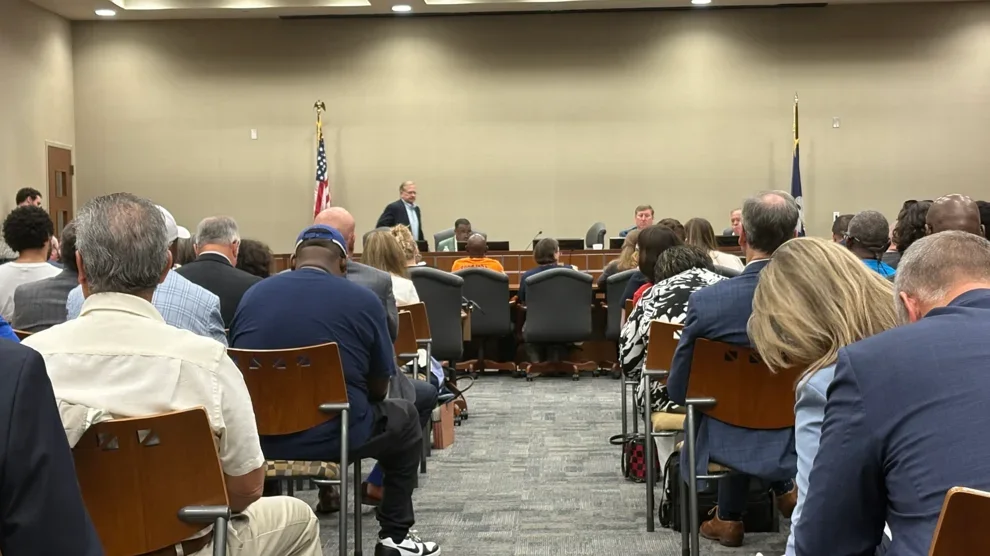
The Louisiana Public Service Commission meets to decide on a motion to subpoena records from Meta. Credit: Photo: Nolan Mckendry / The Center Square
By Nolan Mckendry | The Center Square
(The Center Square) – Louisiana utility regulators sided with Meta on Wednesday, blocking an order that would have forced the tech giant to turn over records showing how it calculated the jobs and electricity demand behind its massive Richland Parish data center expansion.
The Louisiana Public Service Commission reversed a ruling from Chief Administrative Law Judge Melanie Verzwyvelt, who had ordered Meta to produce documents substantiating its projections for investment, permanent job creation and power consumption.
The decision kills, for now, an effort by the Alliance for Affordable Energy and Union of Concerned Scientists to look behind numbers that have become central to Entergy Louisiana's argument that another multibillion-dollar buildout to serve Meta is in the public interest.
The commission had formally placed Meta's request for immediate review of Verzwyvelt's ruling on Wednesday's agenda in Entergy's pending generation case.
The hearing quickly became contentious, with commissioners facing pointed criticism from speakers and occasional outbursts from the audience over how much information regulators should require from one of the largest economic development projects in Louisiana history.
At one point, an audience member shouted an accusation that Commission Chairman Eric Skrmetta was "on Meta's payroll."
Much of the frustration centered on a basic question: If Meta's projected jobs and power demand are being used to justify billions of dollars in new power infrastructure at the cost of ratepayers, should the company have to show how it arrived at those figures?
Democratic congressional candidate Lindsay Garcia told commissioners that asking the public to accept the projections without access to the underlying information amounted to demanding trust.
"Here's the problem: when you tell the people, 'Trust us, we're bringing jobs,' while simultaneously keeping the terms, negotiation projections and supporting information behind NDAs and confidentiality walls, you're not asking for trust," Garcia said. "You're demanding it from us, and government does not get to demand blind trust from the people it serves."
"The people of Louisiana are not shareholders in Meta," she added.
Neither Meta nor Entergy offered testimony defending the projections during the exchange.
Entergy regulatory affairs director Larry Hand was asked if he wanted to comment but declined and did not testify. A representative for Meta was also offered an opportunity to testify and declined.
The subpoena dispute dates to June, when the Alliance for Affordable Energy and Union of Concerned Scientists sought several categories of information directly from Meta as they challenge Entergy's latest request to expand the power system for the company's data center campus.
Verzwyvelt granted the request in part on July 10.
She ordered Meta to provide records supporting its projected investment and permanent job creation, as well as information supporting its anticipated electricity demand. She rejected broader requests for detailed load patterns, sustainability communications and information about Meta's assets and other financial guarantees.
The records would have been produced as part of the regulatory proceeding; the ruling was not an order requiring all of Meta's confidential information to be released publicly.
Meta nevertheless challenged the subpoena, arguing that the material contained confidential business information and trade secrets and that the requests were unreasonable and unnecessary. Verzwyvelt later declined to reverse herself, sending Meta's appeal to the full five-member commission.
Wednesday's vote erased that portion of the judge's discovery order.
Entergy is seeking approval to build seven company-owned natural gas generators, along with three battery-storage projects and hundreds of miles of transmission infrastructure to accommodate the additional demand.
The commission has already agreed to consider the overall application on an accelerated timetable.
Meta's own projections have grown substantially while that review has been underway.
Louisiana officials originally announced the Richland Parish development in 2024 as a roughly $10 billion project expected to create at least 500 permanent jobs. Meta announced in July that its investment would exceed $50 billion, that the campus would reach 5 gigawatts of computing capacity and that it would provide more than 1,000 operational jobs.
The subpoena would have allowed the consumer groups to examine the calculations behind those projections rather than relying solely on Meta's public statements.
That matters because Entergy has repeatedly argued that Meta's extraordinary electricity demand can benefit its other customers rather than burden them. The utility estimates its agreements with Meta will deliver roughly $2.65 billion in customer savings and other benefits over 20 years and says Meta will pay the costs associated with serving its facilities.
Consumer advocates dispute whether those protections eliminate the long-term risk to ratepayers, particularly if Meta's electricity needs fail to materialize as projected or the company eventually reduces its presence.
The commission will ultimately have to weigh those competing claims when it considers Entergy's application in December.
After Wednesday's decision, however, the groups challenging the project will have to do so without the underlying Meta records the administrative law judge had determined they were entitled to obtain.