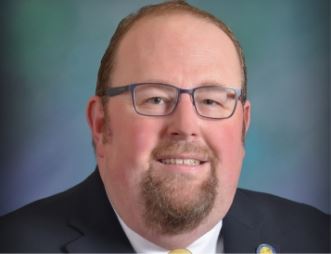
Grayson Boucher
Shreveport City Council — District D
Look, I've tried to be a straight shooter with the people of Shreveport for the past eight years I've served on the City Council. I've never claimed to have all the answers, but I've always believed that when we're spending taxpayers' money, we owe the public an honest accounting of the facts.
So here are my thoughts on the proposed $70 million Caddo Parish sports complex.
First, let me say that I support youth sports, recreational opportunities, and economic development. Economic development is key to the growth and future of our community. Attracting tournaments, visitors, and new businesses to Caddo Parish is certainly a worthwhile goal.
But I also believe we have to look at the entire financial picture.
LET'S TALK ABOUT OUR EXISTING DEBT.
Based on previously reported financial statements, the City of Shreveport, Caddo Parish Commission, and Caddo Parish School Board have approximately $1.15 BILLION in combined outstanding bond principal.
That's billion with a B.
Here's how those previously reported figures break down: 2025
City of Shreveport: $1.015 billion
Caddo Parish Commission: $38.6 million
Caddo Parish School Board: $95.4 million
Not all of that debt is supported by property taxes. Some is paid through water and sewer revenues and other dedicated funding sources. Nevertheless, these are financial obligations that must be repaid.
When allocated across the population, that represents approximately $6,367 per Shreveport resident and $598 per resident living in Caddo Parish outside the city limits. These are not individual tax bills, but they illustrate the scale of our existing public debt.
AND THEN THERE'S THE EPA CONSENT DECREE.
According to an April 2025 public report, Shreveport had already spent approximately $620 MILLION addressing federally mandated sewer improvements, with substantial work still remaining.
Based on escalating costs and ongoing infrastructure requirements, the City could be facing ANOTHER $500 MILLION OR MORE IN FUNDING NEEDS OVER THE NEXT TEN YEARS.
Much of that could require additional water and sewer revenue bonds, potentially placing further pressure on utility rates for residents and businesses.
Anyone who has lived in Shreveport for any length of time knows we have aging infrastructure that simply cannot be ignored.
And this brings me to what I believe is one of the most important points in this entire discussion.
After eight years of reviewing budgets, capital improvement projects, and bond proposals, it is my contention that Caddo Parish, and particularly the City of Shreveport, may be approaching the practical limits of how much additional debt we can responsibly take on.
I'm not suggesting we've reached a legal borrowing limit. But there comes a point when we have to ask ourselves how much more debt our residents and businesses can reasonably afford to support, especially with the infrastructure obligations we already face.
NOW, BACK TO THE SPORTS COMPLEX.
Caddo Parish is asking voters to authorize another $60 MILLION IN GENERAL OBLIGATION BONDS toward construction of a proposed $70 MILLION SPORTS COMPLEX.
Parish officials have indicated that the proposal would not require an increase in the existing tax rate. That's an important distinction.
BUT NO INCREASE IN TAXES DOES NOT MEAN NO ADDITIONAL DEBT.
Which brings me to another question.
HAVE WE FULLY EXPLORED THE POSSIBILITY OF PUBLIC-PRIVATE PARTNERSHIPS?
Economic development doesn't always have to mean government borrowing the entire amount. Private developers, corporate sponsors, investors, and facility operators may be willing to participate in financing and operating projects like this.
Public-private partnerships aren't without challenges, but they can provide opportunities to share costs and financial risks rather than placing the entire burden on taxpayers.
Before committing another $60 million in public borrowing, I believe we should understand whether those alternatives have been seriously evaluated.
There are also some basic questions that deserve answers:
What will the total cost be, including interest over the life of the bonds?
What will it cost annually to operate and maintain the complex?
What happens if projected tournament revenues and economic benefits fall short?
Could private investment or partnerships reduce the amount of public borrowing required?
How will this financial commitment affect our ability to address other pressing needs?
I'm not telling anyone how to vote. That's a decision each voter must make.
But after eight years on the City Council, one thing I've learned is that every financial decision we make today affects what we can afford tomorrow.
We need economic development. We need opportunities for our young people. And we need to be responsible with public money.
At the end of the day, it's about understanding what we owe, what we're proposing to spend, and most importantly, HOW WE'RE GOING TO PAY FOR OUR FUTURE.